
Why Your Pain Keeps Coming Back (And How Our 4-Step Protocol Stops the Cycle)
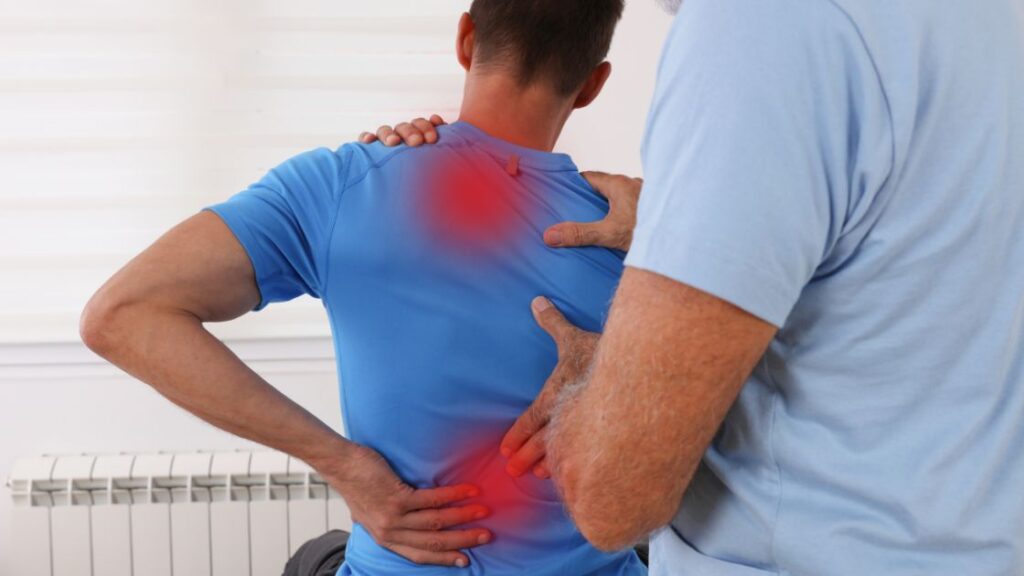
You’re in pain, so you get a massage. Your massage therapist tells you to stretch, so you stretch. Then hydrate, and then you rest. You’re already feeling better!
But then the pain returns. More often it’s weeks or even months later, but sometimes those nasty aches are back within a matter of days. What happened?
The all too common neck and shoulder pain has resurfaced. The low back is tight. The headaches have returned with a vengeance. Why is this happening?
Pain, more often than not, has more than one cause. Actually, the spot that hurts won’t always be the main source of the issue. When one area becomes restricted, other areas often compensate. As time passes, the overcompensations lead to a cycle of tension, limited range of motion, and recurring pain.
A Better Way to Break the Pain Cycle
At Moyer Total Wellness, our approach focuses on breaking that cycle with the implementation of our 4-step treatment protocol. Let’s get into how each step works!
Step 1: Remove Muscle Knots
Muscle knots are tight spots embedded in muscular tissue that can cause pain, stiffness, and limited motion.
Before your body can move with more ease, the areas holding tension need to be addressed. By loosening these areas of irritation, normal muscle function is restored when the tension is released.
Step 2: Lengthen Shortened Tissues
If muscular and connective tissue stay tight for too long, they tend to adapt to a locked-short position. This hyper-contraction limits flexibility, negatively impacts posture, and forces your body to compensate.
After releasing the restrictions caused by muscle knots, the second step is to help the tissues regain adequate length to allow your body to move with less resistance.
Step 3: Mobilize Affected Joints
Muscle tightness and restrictions affect how joints move. If a joint can’t reach its full range of motion, the surrounding muscles have to pick up the slack. This spreads more tension and discomfort to other areas of the body. Mobilizing joints helps restore more fluid movement which allows your body to function with more efficiency.
Step 4: Strengthen Weak Muscles
When one muscle group tightens, the opposing muscle group weakens. Releasing tension alone without addressing weakness can cause the same detrimental patterns to return.
Strengthening the muscles that can’t optimally do their job will help your body maintain better posture, balance, and movement patterns.
Now You Know!
Coming in to see us for relief is great! But seeking us out for long term change is better. Treating the pain by itself should only be one part of your recovery. Addressing knots, flexibility, mobility, and strength is what you really need to help your body restore a healthier balance.
Don’t let your body continue to adapt to patterns that cause pain. With our 4-step approach, you can change those patterns for the better.
Break the cycle. Your body will thank you!

Katrina Jenkins
Author, Licensed Massage Therapist
Katrina Jenkins graduated from Towson University in 2013 with a Bachelor’s Degree in Health Science and worked as a nurse’s aide briefly before pursuing her true passion. She graduated from the Massage Therapy Institute of Colorado in April 2016 with honors and completed the Touch of Healers Scholarship Program the following summer. She has been a part of the Moyer Total Wellness Team since the summer of 2017.
Resources
Cheng, J.O.S. and Cheng, S.-T. (2019). Effectiveness of physical and cognitive-behavioural intervention programmes for chronic musculoskeletal pain in adults: A systematic review and meta-analysis of randomised controlled trials. PLOS ONE, 14(10), p.e0223367. doi:https://doi.org/10.1371/journal.pone.0223367.
Espejo-Antúnez, L., Tejeda, J.F.-H., Albornoz-Cabello, M., Rodríguez-Mansilla, J., de la Cruz-Torres, B., Ribeiro, F. and Silva, A.G. (2017). Dry needling in the management of myofascial trigger points: A systematic review of randomized controlled trials. Complementary Therapies in Medicine, 33, pp.46–57. doi:https://doi.org/10.1016/j.ctim.2017.06.003.
Ribeiro, D.C., Belgrave, A., Naden, A., Fang, H., Matthews, P. and Parshottam, S. (2018). The prevalence of myofascial trigger points in neck and shoulder-related disorders: a systematic review of the literature. BMC Musculoskeletal Disorders, 19(1). doi:https://doi.org/10.1186/s12891-018-2157-9.
Smith, B.E., Hendrick, P., Smith, T.O., Bateman, M., Moffatt, F., Rathleff, M.S., Selfe, J. and Logan, P. (2017). Should exercises be painful in the management of chronic musculoskeletal pain? A systematic review and meta-analysis. British Journal of Sports Medicine, 51(23), pp.1679–1687. doi:https://doi.org/10.1136/bjsports-2016-097383.