
How Massage Therapy Eases Muscle Stiffness and Improves Flexibility
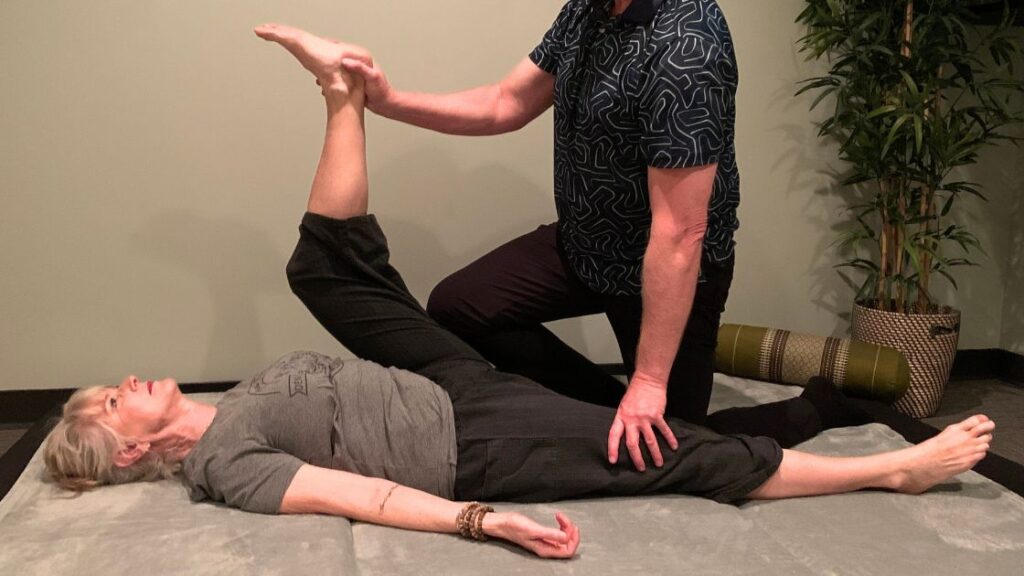
Stiff muscles and restricted mobility are the most common issues massage therapy targets. Injuries, overuse, inactivity, chronic conditions, and/or daily stressors are all contributors to these types of discomfort.
If left untreated, tense muscles and limited movement lead to pain, altered posture, poor body mechanics, and the possibility of further injury. Thankfully, massage therapy is an easily obtainable treatment that offers a holistic and effective way to ease stiffness and improve flexibility. Today, we’ll discuss how our four-step protocol aims to reduce that stiffness and enhance joint range of motion.
But first? What is the four-step treatment plan at Moyer Total Wellness?
- Remove knots from tight muscular tissue
- Lengthen locked-short muscle
- Strengthen weak muscles
- Mobilize restricted joints
How each step eases stiffness and improves flexibility:
Knot Removal
Knots cause muscles to become chronically contracted. This hyper-contraction puts a limit on how far a muscle can stretch itself, preventing it from fully relaxing. Removing knots allows the muscle to regain its intended length and elasticity, which then restores its ability to properly function.
Lengthening
The lengthening of muscle fibers that follows knot removal affects how muscles respond to stretching. Long muscles are less resistant to movement because the fascia becomes more pliable. With better elasticity, lengthened muscles stretch and recoil more easily.
Strengthening
Weaker muscles fatigue more quickly and are more susceptible to injuries such as muscle tears – which set off the inflammatory response and cause stiffness. Stronger muscles are resilient – recovering faster and maintaining their looseness following exertion.
Building strength balances muscle tension by preventing the overcompensation of other muscles. Even musculature contributes to better joint support, a benefit which hinders the potential for mobility-limiting injury.
Mobilization
Following knot removal, tissue lengthening, and muscle strengthening, joint range of motion can significantly increase. This is because knots (as mentioned above) limit how far the muscle can stretch, and this directly restricts the movements at the joints it connects to. When muscle fibers return to a more elongated state, joint range of motion becomes wider.
Strong muscles increase support and control of the joints. A stabilized joint is a smoothly moving joint. Strengthening also ensures that the agonist and antagonist muscle groups surrounding the joint work synergistically, letting the joint move as freely as is possible.
Now You Know!
Experiencing stiffness or restricted joint range of motion? Schedule a massage today and experience what the four-step protocol can do for your musculoskeletal health!

Katrina Jenkins
Author, Licensed Massage Therapist
Katrina Jenkins graduated from Towson University in 2013 with a Bachelor’s Degree in Health Science and worked as a nurse’s aide briefly before pursuing her true passion. She graduated from the Massage Therapy Institute of Colorado in April 2016 with honors and completed the Touch of Healers Scholarship Program the following summer. She has been a part of the Moyer Total Wellness Team since the summer of 2017.
Resources
Cronkleton, E. (2019). What Is Muscular Strength, and What Are Some Exercises You Can Do? [online] Healthline. Available at: https://www.healthline.com/health/exercise-fitness/muscular-strength.
Inami, T., Yamaguchi, S., Kim, H.-K., Miyagawa, H. and Murayama, M. (2024). Relationship between changes in muscle stiffness after a comfortable massage and the massage pressure. Journal of Bodywork and Movement Therapies, [online] 39, pp.350–355. doi:https://doi.org/10.1016/j.jbmt.2024.03.025.
Shah, J.P., Thaker, N., Heimur, J., Aredo, J.V., Sikdar, S. and Gerber, L. (2015). Myofascial Trigger Points Then and Now: A Historical and Scientific Perspective. PM&R, [online] 7(7), pp.746–761. doi:https://doi.org/10.1016/j.pmrj.2015.01.024.
Yildiz, S., Ertugrul Gelen, Murat Çilli, Hasan Karaca, Gurhan Kayihan, Ozkan, A. and Cetin Sayaca (2020). Acute effects of static stretching and massage on flexibility and jumping performance. Journal of Musculoskeletal & Neuronal Interactions, [online] 20(4), p.498. Available at: https://pmc.ncbi.nlm.nih.gov/articles/PMC7716682/.
Photo Credit
Moyer Total Wellness